Showing posts with label mainboard. Show all posts

ASUS Dual-Socket LGA2011 Motherboard Pictured

Click to zoom


At CES, ASUS showed off its latest workstation motherboard designed for 2P socket LGA2011 Sandy Bridge-EP eight-core processors, the Z9PE-D8-WS. By the looks of it, it might not be having the voltage-delivery muscle of EVGA's SR3, but it is filled to the brim with connectivity. Each socket is powered by a 14-phase Digi+ II VRM, there are numerous other power domains. The board draws power from a 24-pin ATX connector, two 8-pin EPS connectors, and a 4-pin Molex.

Sapphire Announces Pure Platinum A75 Motherboard for AMD A-Series APUs


SAPPHIRE Technology, a leading manufacturer and global supplier of graphics, mainboard and multimedia solutions has just introduced a new mainboard developed to support the latest A-series Fusion APU family from AMD.

ASRock Unveils Fatal1ty 990FX Professional Motherboard


ASRock unveiled the first Fatal1ty-branded AMD platform product, a premium motherboard based on the AMD 990FX chipset, ready for AMD FX series processors in the AM3+ package. The board sports the signature Fatal1ty color scheme of black and red, and is geared for high-end gaming PCs. The AM3+ socket is powered by a 14-phase digital PWM power design, which is ready for even 140W chips. It is wired to four DDR3 DIMM slots supporting dual-channel DDR3 with speeds of over 2000 MHz by overclocking.


ZOTAC Readies Monster LGA1155 Motherboard

ZOTAC entered the motherboard scene as yet another vendor of reference NVIDIA nForce motherboards, which the like of EVGA, XFX, and BFG also sold. After the fall of nForce, ZOTAC attempted a LGA1366 motherboard, and went dormant with motherboards. Later, it picked up interest in the mini-ITX form-factor as it gained popularity in Asian markets like China and India, manufacturing motherboards based on Intel Atom, Atom with NVIDIA ION, and eventually socketed mini-ITX motherboards as it became a 2-chip affair with Intel's Ibex Peak platform (LGA1156). It looks like Zotac is making a comeback into full-size ATX motherboards that target the very top tier of the market, to woo gamers, professional overclockers, and enthusiasts.

MSI Launches the World’s First PCI Express Gen.3 Mainboard

MSI, the world-renowned mainboard and graphics card manufacturer, officially launches the Z68A-GD80 (G3), featuring world’s first large bandwidth PCI Express Gen 3 mainboard, and the latest UEFI technology: Click BIOS II which features a homogenous interface both under Windows and the UEFI interface. Conforming to Intel’s latest design standard, the MSI Z68A-GD80 (G3) with PCI Express Gen 3 provides a data transfer rate that is 200% faster than PCI Express Gen 2, enhancing the performance of graphics cards without bandwidth limitations.

Biostar Unveiled Two AMD Llano Micro-ATX Motherboard


In addition to marketing the motherboard has a stylish TA75A + Full ATX, Biostar also reportedly been re-introduced two new solutions to the model TA75M FM1 + and TA75M equally use a micro ATX form factor. And for those who are interested in building a HTPC system or gaming systems based on the latest Llano APUs, reportedly can use both solutions offer the FM1 is Biostar.

Latest AMD 900-Series Motherboard supports SLI

Earlier this month, AMD has just released a 900-series chipset newest destined for the existence of AM3/AM3 + processor-based. And one of the most important features brought by this new design is support for Nvidia SLI technology.
Now more than a week after the chipset was released, SLI seems to still be activated as when Nvidia still has not released drivers that support dual-GPU setup. This problem is revealed by the publication Expreview trying to review the Nvidia SLI setup on the existence of new 990FX motherboard supported by the latest AMD chipset.

Review Gigabyte G1.Assassin: High End Class Gaming Motherboard Military Themed

In the midst of the hustle and bustle of Sandy Bridge Intel platform, GIGABYTE motherboards using the re-release of the Intel X58 chipset is Gigabyte G1-Killer Series. In contrast to previous Intel X58 motherboards from Gigabyte, Gigabyte G1-Killer Series is a military-themed gaming motherboard. This is the first time released a gaming Gigabyte motherboard. Gigabyte G1-Killer Series provides many features to pamper players who use them. Gigabyte provides its own nicknames for these features, namely Super Sight, Super Hearing, Super Speed​​, and Super Shield.

ASRock Announces New Motherboards Based on AMD 9-Series Chipset

AMD’s latest AM3+ processors are a shot in the arm for PCs, delivering start of the art processing at unmatched performance. ASRock superior AMD 9 series motherboards have been designed to support the new-gen AM3+ processors, while still retaining backward compatible with AM3 processors and unprecedentedly implementing support for SLI technology. To bring the best kit to users, ASRock has thrown everything you could want from the new-gen AMD 9 series motherboards. The innovative features include the ASRock signature XFast USB, On/Off Play Technology, Graphical UEFI, All-in-one AXTU program, and so on.


Unleash The Maximum PC Power : 990FX Extreme4
ASRock 990FX Extreme4 motherboard is ASRock’s top-of-the-range model. Powered by AMD 990FX and SB950 chipsets, this board features Premium Gold Caps, advanced V8 + 2 Power Phase Design and multi-GPU options. ASRock AMD 9 series mainboards also allow users to easily unleash their system's hidden USB performance with ASRock’s innovative XFast USB Technology. Designed for the next generation computing, this board still supports AM3+ socket and is compatible of 8-Core series processors.

Do you desire to make SLI technology running on AMD motherboard? Well, ASRock 990FX Extreme4 allows users to take advantages of both CrossFireX and SLI technologies. We always give you more than you expected!

Performance Gear - 970 Extreme4
Meanwhile, ASRock also introduces another great motherboard: 970 Extreme4. Based on 970 chipset, this board is marked by its versatile solutions. To name a few, 3 PCI Express slots cater for multi-GPU settings, manageable smart switches and Dr. Debug, offering flexible options which will appeal to DIY users. Beside its onboard equipments, this board also features superior software tools such as mouse-controllable Graphical UEFI, XFast USB that optimizes USB transfer speed performance and On/Off Play technology.

What makes this board becomes more distinctive; however, it’s the SLI technology. The ASRock 970 Extreme4 is the first AMD 970 motherboard supporting Nvidia SLI technology in the world! With a wide range of prominent functions, advanced DIY users should not miss 970 Extreme4!

970 Extreme4
The latest ASRock AMD 9 series motherboards come with a bucketful of technologies aimed at delivering the ultimate PC experience.

source: www.techpowerup.com

Corsair Announces Vengeance Low Profile High-Performance DDR3 Memory Kits

Corsair, a worldwide designer and supplier of high-performance components to the PC gaming hardware market, today announced Vengeance LP, the latest addition to the award-winning Vengeance Series high-performance DDR3 line.

Vengeance LP memory features heat spreaders with a reduced height of 1.03" (26.25 millimeters), compared to the standard height of 1.87" (47.37 millimeters). These modules are designed for high-performance systems with extra-large CPU coolers, small form factor system builds, or other space-constrained applications that prevent the use of standard Vengeance memory.

Vengeance LP memory kits will be available in a variety of colors, including Jet Black, Cerulean Blue,and a Special Edition Arctic White. Like the original Vengeance, all Vengeance LP modules are designed to operate at 1.5V, making them ideal for use in 2nd Generation Intel Core processor systems. The Special Edition Arctic White models operate at the ultra-low voltage of 1.35V.

"Vengeance is the premier choice for system builders and gaming enthusiasts who want dependable, overclockable memory for a great price." said Giovanni Sena, Director of Memory Products at Corsair. "Our new low-profile Vengeance LP memory gives enthusiasts more freedom and flexibility in building high-performance PCs."

Vengeance Low Profile memory kits will initially be available in the following configurations. All module kits are compatible with current Intel and AMD platforms. Corsair Vengeance LP memory kits will be available in June from Corsair’s worldwide network of resellers and distributors.
source:www.techpowerup.com

Ultimate DIY Performance PC: EVGA & Intel Infused

Every once in a while a product comes along that really gets us worked into a frenzy. Typically, the latest and greatest processors and graphics cards generate a lot of buzz around here, but some other components aren’t always as enticing for one reason or another, like motherboards for example. Don’t get us wrong, we love a great enthusiast-class motherboard with a ton of features as much as the next guy, but the majority of them just don’t have the appeal of new CPU or GPU.

There are exceptions, of course. Most recently, a number of Asus’ RoG, Gigabyte’s Ultra Durable, and MSI’s Big Bang boards come to mind. And looking back boards like the legendary Abit BP6 and even the VP6 were great. The dual-socket configurations of the BP6 and VP6 were of particular interest to many enthusiasts, because when paired with the right processors and workloads they could offer performance that no single-socket board could match. The big two processors manufacturers have even used dual-socket or 2P platforms to showcase cutting-edge “desktop” products from time to time, like AMD’s Quad Father or Intel’s Skulltrail.
Dual socket motherboards have been a mainstay in the workstation market for ages, but they’re not as common in the enthusiast space. So, when we see one, we’re usually excited to check it out.

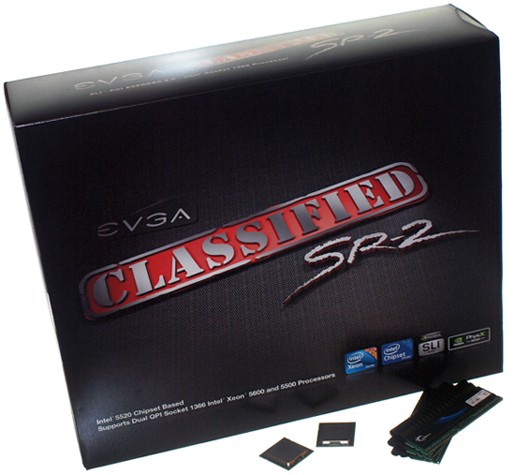
Such was the case with the EVGA Classified SR-2. We first laid our hands on the Classified SR-2 at CES 2010 and were recently given the opportunity to take one for a spin around the lab. While preparing to test the board, however, a couple of important points led us in a somewhat different direction than a straight-up motherboard review. The EVGA Classified SR-2’s requirements are unlike any other desktop motherboard you’ve seen to date. And to meet those requirements meant reeling in some other exciting hardware in its own right.

On the pages ahead, not only will we be checking out the EVGA Classified SR-2, but we’ll be showcasing a pair of the most powerful processors currently on the market, along with the only 6-Channel CAS 6 memory kit available and an as-yet-to-be released case capable of housing it all. The end result is arguably the most powerful foundation for desktop PC platform an enthusiast could wish for to date.

 
EVGA's Classified SR-2, two Intel Xeon 5680 Processors, and G.SKILL's CAS 6 RAM
 Specifications:

The EVGA Classified SR-2's specifications hint at the board's extreme nature, but don't tell the whole story by any means. We'll dig deeper on the pages ahead, but first we should talk about the chipset at the heart of the SR-2, Intel's 5520. It, after all, is the foundations that brings all of the board's integrated features together.
Intel 5520 Chipset Block Diagram
The Intel 5520 chipset is somewhat similar to the X58 Express in terms of its features, but it obviously targeted at the high-end workstation market as is evidenced by its multiple QPI links and support for Xeon series processors. Like its desktop-bound counterpart, The 5520 IOH is paired to the ICH10R Southbridge, which adds PCI Express Gen 1, Serial ATA, USB 2.0, and Ethernet connectivity. Due to the fact that Xeon 5500 / 5600 series processors feature integrated on-die memory controllers, the 5520 IOH isn't a traditional Northbridge. It does, however, sport multiple QPI links and 36 lanes of PCI Express 2.0 connectivity.
source:hothardware.com

Gigabyte X58A-UD3R: USB 3.0, SATA 6G

The past few years have been very kind to Gigabyte; the company's shipments have increased to the point that it's now approximately tied with Asus in terms of volume shipments. Part of the reason for the company's good fortune is its decision to aggressively align its higher-end motherboards, both in terms of price and available features. Gigabyte has put a major push behind USB 3.0, and claims to have purchased one million of the three million USB 3.0 controllers NEC has shipped thus far.
The X58A-UD3R we're reviewing today is a good example of Gigabyte's competitive product positioning. The board's feature loadout is excellent given its ~$200 price point—the question we'll be looking to answer is whether or not the company cut any corners to hit its target.
Processor and Chipset
Based on Intel X58/ICH10R chipset
Supports Intel Core i7 Processors

Memory
6 x DIMM, Max. 24 GB, DDR3 2000(O.C.)*/1866(O.C.)*/1800(O.C.)*/1600(O.C.)/1333/1066 ECC,Non-ECC,Un-buffered Memory
Triple channel memory architecture
Support Intel Extreme Memory Profile (XMP)
   
Expansion Slot
4 x PCIe physical x16
1 x PCI
2 x PCIe x1

SLI / Video Card Configurations*:
Single Card: Slot 1 (x16)
SLI/Crossfire: Slots 1 & 3 (x16, x16)
Tri-SLI/TriFire: Slots 1, 3, & 4: (x16, x8, x8)
QuadFire:  Slots 1-4: (x8, x8, x8, x8)
   
Storage I/O
Intel ICH10R controller
6x SATA 3 Gb/s ports
Intel® Matrix Storage supporting SATA RAID 0, 1, 10, and 5

Marvell 9128 SATA 6G Controller
2x SATA 6Gb/s Ports (RAID 0 + RAID 1)

Gigabyte SATA2 (JMB362)
1x IDE (ATA133)
2x SATA 3Gb (RAID 0 / RAID 1)

JMicron JMB362
2x eSATA USB/eSATA external ports
   
Integrated Peripherals
1 x Realtek 8111D  Gigabit LAN
Realtek ALC889, 7.1-Channel High Definition Audio
Multi-Streaming
Jack-Sensing
Front Panel Jack-Retasking
Coaxial / Optical S/PDIF out ports at back I/O
12 USB 2.0 ports
   
Multi I/O
1 x PS/2 Keyboard
1 x PS/2 Mouse
2 x USB 2.0/eSATA
4 x USB 2.0/1.1
2 x USB 3.0/2.0
2 x IEEE1394 (FireWire 400)
1 x Clear CMOS
1 x S/PDIF Out (Coaxial)
1x S/PDIF In (Coaxial)
1 x LAN(RJ45) port
6 x Audio
  

Special Features
@BIOS
Q-Flash
Xpress BIOS Rescue
Download Center
Xpress Install
Xpress Recovery 2
EasyTune
Dynamic Energy Saver 2
Smart 6
Auto Green
eXtreme Hard Drive
Q-Share

Internal IO
24-pin EATX Power connector
8-pin ATX +12V Power connector
1 x Floppy Drive
1 x IDE Drive
1 x CPU Fan Header
3 x System fan header
1 x fan header
1 x North bridge fan header
1 x front panel header
1 x front panel audio
1 x CD-In
1 x S/PDIF In
1 x S/PDIF Out
2 x USB 2.0 Headers
1 x IEEE1394 / Firewire 400

Accessories
Anti-Virus Software (OEM version)
Adobe Acrobat Reader
Firefox 3.5


ATX Form Factor
12 inch x 9.6 inch ( 30.5 cm x 24.5 cm )

  • Supports NVIDIA 2-Way and 3-Way SLI technology
  • Supports ATI CrossFire (2-way/3-way listed, quad support implied)
 
The X58A-UD3R packs all the standard features we'd expect from an LGA1366 motherboard, its six RAM slots, support for multiple video cards, and its plethora of USB 2.0 ports are all checked boxes on the usual list. Where the UD3R stands out is its storage capabilities, the board sports 10 SATA ports, an ATA port, and two combination USB 2.0/eSATA ports. Toss in the USB 3.0 ports and the X58A is capable of handling up to 16 hard drives at (or very near) native interface speeds. That's before we count external enclosures connected via USB 2.0, FireWire, or through the use of add-on cards.

Average Bundle, Excellent Documentation:
The included cables and various items are bog-standard (we dislike the lack of eSATA cables) but we want to take a moment to compliment Gigabyte's manual. When you've been building computers for a decade or more it's easy to overlook the importance of a well-written guide. Happily, Gigabyte didn't. The X58A-UD3R's manual weighs in at 125 pages, nearly all of them useful.

Gigabyte has diagrammed and documented the board's components, BIOS features, and bundled utilities and provided a step-by-step (and screenshot-by-screenshot) how-to on setting up a RAID array or installing an appropriate AHCI driver for Intel's ICH10, the JMicron controllers, or the onboard Marvell 9128 SATA 6G chip. The manual wraps up with a brief tutorial on configuring surround sound speakers; anyone who's curious can take a peek at the digital version
here.

We can't say for certain if Gigabyte has provided this level of documentation for all its current motherboards, but this is precisely the sort of value-added feature that can make a practical difference to anyone whose nervous about building a system. Bravo.

source:hothardware.com

Questions of Compatibility: AMD, AM3, and Bulldozer

It's been several weeks since Asus announced that certain socket AM3 motherboards would support AMD's upcoming Bulldozer processors. Since then, we've turned up additional rumors on the nature of such support. MSI has also announced its own plans to retrofit some existing AM3 boards with Bulldozer compatibility. What follows is the general shape of the situation as we currently understand it.

Will AMD Officially Support Bulldozer On The AM3 Platform?

No. The recent announcements from Asus and MSI make it clear that some AM3 boards will function with a Bulldozer-class processor installed. With that said, AMD originally justified moving from AM3 to AM3+ because not doing so would prevent certain Bulldozer features from functioning. AMD has not specified which features are affected yet; it's our belief, based on conversations with people in the know, that Bulldozer's advanced power management and clock gating capabilities require an AM3+ socket.

What's The Difference Between Unofficial and Official Support?
Quite a bit. For one thing, "unsupported" is almost always code for "voids your warranty." Official support doesn't automatically translate into practical compatibility. AMD has officially supported two separate product introductions in recent history. First, all AM2 boards that supported Phenom officially supported Phenom II. Second, all AM2+ boards officially supported AM3 processors. In both cases, actual compatibility implementation was left in the hands of the motherboard manufacturers.

There are occasionally cases where neither official support nor proper BIOS implementation is sufficient. AMD's 780G chipset, which launched to considerable acclaim, was capable of supporting AMD's entire range of processors. It soon became apparent, however, that a number of mATX 780G  boards were incapable of handling AMD's 125W Phenom processors. Well-built boards using high-quality components had no problems. The rest were quickly restricted to 95W TDPs or less.


What Have Asus / AMD Said?

AMD has officially said that it will support Bulldozer with the Socket AM3+ infrastructure. Questions regarding Bulldozer and AM3 support should therefore be directed to the motherboard manufacturers in question*. We attempted to talk to Asus, but were told that the company will no longer be talking publicly about AM3/Bulldozer support, at the request of AMD. Thus, Asus was unable to talk to us about the specifics of its own product based on an announcement it had already made.

What's The Bottom Line?
Some AM3 boards will support Bulldozer processors. The characteristics of that support and the degree to which performance, power consumption, and thermals will be affected is unknown. We generally expect that more expensive, enthusiast-class boards will offer a greater degree of support than bargain-basement models. Similarly, companies are more likely to update newer, better, boards than older ones.

The rumor mill indicates that multiple AMD chipsets will be capable of supporting Bulldozer. There's scant info on just how much various companies will implement support on older boards. Expect actual compatibility to vary considerably. The nature of this situation makes it very likely that some boards that should support Bulldozer, won't. Others may not be able to deliver power adequately given the CPU's different requirements.

The best thing to do is wait and see. We'll have to wait for launch to see what disparities exist between AM3 and AM3+ features and performance. We expect other motherboard manufacturers will make their own announcements about AM3 compatibility in the weeks ahead, but in lieu of the unofficial nature of support, we recommend waiting as opposed to buying a board now with a plan to drop an AM3+ processor in it.
source:hothardware.com

MSI's AM3 Motherboards to Support AM3+ "Bulldozer" Microprocessors

MicroStar International (MSI), a leading maker of mainboards, on Monday said that select platforms originally designed for current-generation central processing units (CPUs) in AM3 form-factor will support the forthcoming AMD FX-series chips with Bulldozer micro-architecture in AM3+ package.
Various AM3 mainboards from MSI based on various AMD 7-series and AMD 8-series chipsets will support AM3+ microprocessors after a BIOS update. This will allow end-users, who own appropriate platforms, to upgrade to multi-core AMD FX-series CPUs code-named Zambezi once they become available in the coming months. At present MSI offers BIOS updates for three mainboards, but the list contains fourteen models and will be updated.
The maker of motherboards implied that the AM3 mainboards will support all the advanced capabilities of chips based on Bulldozer micro-architecture, including technologies that improve power efficiency as well as Turbo Core 2.0 technology that can dynamically overclock CPUs by up to 500MHz.

Earlier on Monday Gigabyte became the first company in the world to release mainboards with AM3+ socket, which support the next-generation 32nm chips offficially. Meanwhile, Asustek Computer - just like MSI - claims that even its AM3 motherboards will fully support AMD FX-series "Zambezi" processors with Bulldozer micro-architecture.
The first breed of AMD FX8000, FX6000 and FX4000 currently known under Zambezi code-name will completely support all the advantages that the Bulldozer micro-architecture is supposed to bring, including new Flex FP floating point processing unit. The new chips in maximum eight-core configurations are projected - by AMD's internal documents - to offer roughly 50% performance improvement over Phenom II-series microprocessors in multimedia applications.
The Sunnyvale, California-based chip designer plans to introduce AMD 900-series chipsets compatible with Zambezi processors in Q2 2011. The Bulldozer processors, Radeon HD 6000 "Northern Islands" discrete graphics cards  and AMD 900-series core-logic sets will power AMD's next-generation enthusiast-class platform code-named Scorpius.
source:xbitlabs.com

Gigabyte Announce Mainboards for Future AMD FX "Bulldozer" Microprocessors.

Gigabyte Technology, one of the largest makers of mainboards in the world, on Monday unveiled a lineup of mainboards with AM3+ socket designed for AMD FX-series microprocessors code-named Zambezi and powered by AMD's next-generation Bulldozer micro-architecture.
Gigabyte AM3+ "Black Socket" mainboards are powered by AMD's current-generation core-logic sets, including AMD 7-series and AMD 8-series. The new motherboards - which feature a black CPU socket - fully support AMD's next-generation FX-series microprocessors with up to eight cores and made using 32nm process technology. the platforms also support existing AMD Athlon II and AMD Phenom II chips in AM3 form-factor with dual-channel DDR3 memory controllers.
Gigabyte is the first company in the world to release mainboards with AM3+ socket. Meanwhile, Asustek Computer claims that even its AM3 motherboards will support AMD FX-series "Zambezi" processors with Bulldozer micro-architecture.
The first breed of AMD FX8000, FX6000 and FX4000 currently known under Zambezi code-name will completely support all the advantages that the Bulldozer micro-architecture is supposed to bring, including new Flex FP floating point processing unit. The new chips in maximum eight-core configurations are projected - by AMD's internal documents - to offer roughly 50% performance improvement over Phenom II-series microprocessors in multimedia applications.

AMD Orochi design is the company's next-generation processor for high-end desktop (Zambezi) and server (Valencia) markets. The chip will feature eight processing engines, but since it is based on Bulldozer micro-architecture, those cores will be packed into four modules. Every module which will have two independent integer cores (that will share fetch, decode and L2 functionality) with dedicated schedulers, one "Flex FP" floating point unit with two 128-bit FMAC pipes with one FP scheduler. The chip will have shared L3 cache, new dual-channel DDR3 memory controller and will use HyperTransport 3.1 bus.
The Sunnyvale, California-based chip designer plans to introduce AMD 900-series chipsets compatible with Zambezi processors in Q2 2011. The Bulldozer processors, Radeon HD 6000 "Northern Islands" discrete graphics cards  and AMD 900-series core-logic sets will power AMD's next-generation enthusiast-class platform code-named Scorpius.
source: www.xbitlabs.com

EVGA Readies P67 FTW B3 LGA1155 Motherboard


After quite some lull, a new motherboard by EVGA is taking shape, the EVGA P67 FTW B3. As the name suggests, it is a top-tier motherboard by the company, based on the Intel P67 B3 chipset. The P67 FTW ("for the win", in gamer jargon) supports LGA1155 Intel Core i3/i5/i7 processors, and is geared for extreme overclocking of CPU and GPUs, and is particularly laid out for supporting 3-way and 4-way NVIDIA SLI. The board uses an NVIDIA nForce 200 bridge chip over the processor's PCI-Express 2.0 x16 link to give out two x16 links, which are further configured as four x8 links, if four x16 slots are populated with graphics cards.